Training & Instruction

What's Happening

Mobilizing communities to prevent substance misuse, suicide and other unhealthy coping skills and increasing awareness of how negative childhood experiences can impact us throughout our lives.

1639 Jamestown Church
Feb 23

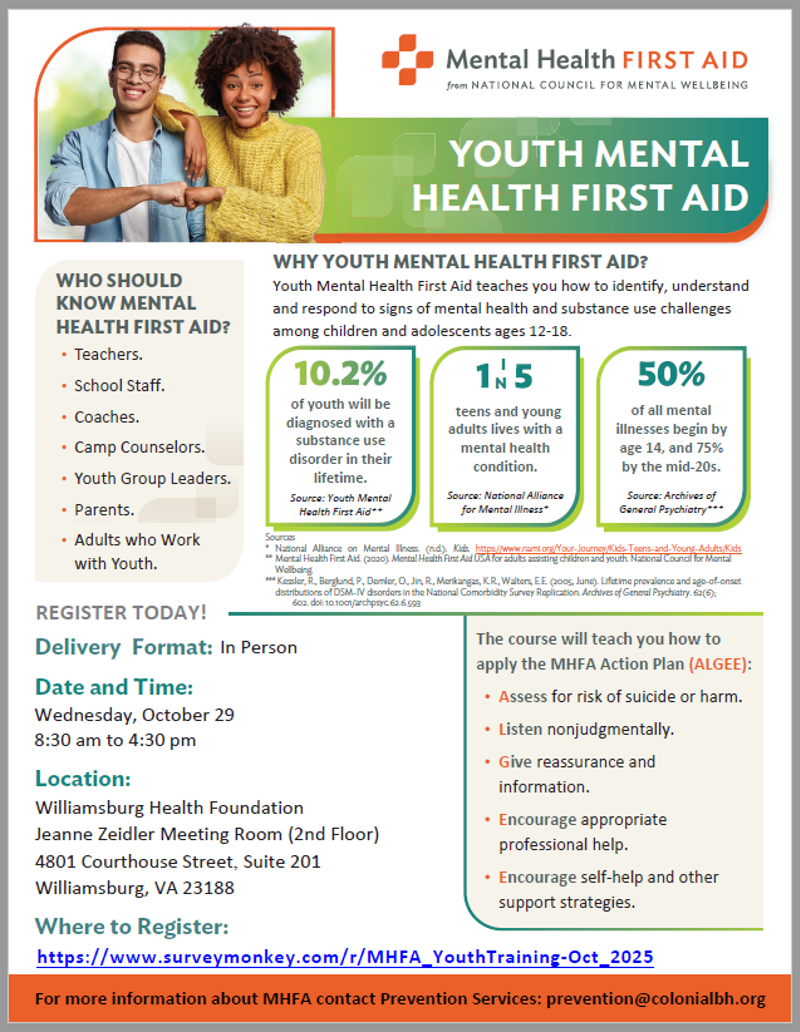
Mental Health First Aid – Youth

9:00 AM Colonial Behavioral Health - Prevention Services is proud to offer FREE Mental Health First Aid – Youth training on Monday, February 23 from 9 am – 5 pm, lunch is provided.   Registration is limited to 15 individuals - click the images below to register for the training of your choice.   Please share with your staff, colleagues, friends, and family members!

Feb 25

ACE Interface Train-the-Presenter in Fredericksburg

9:00 AM Keith Cartwright, DBHDS ACE Coordinator, and Master ACE Interface Trainer is returning to Fredericksburg to facilitate a train-the-presenter for the Understanding Adverse Childhood Experiences (ACEs) and Building Self-Healing Communities. RACSB Master Trainers Michelle Wagaman and Amy Jindra will co-facilitate. The train-the-presenter will be held in-person at the RACSB at River Club office (10825 Tidewater Trail, Fredericksburg, VA 22408). Participants must commit to full attendance each of the three days. (Day 1 and Day 2 – 9:00 a.m. to 4:30 p.m. and Day 3 9:00 a.m. to noonish) Space will be limited to 25 participants. Registration will close 10 days prior to the train-the-presenter or when 25 participants are confirmed. Advance reading will be emailed a week prior to the in-person training.

Feb 25

Developing a Transitional Program to Promote Sustained Recovery Success Post-Graduation

2:00 PM Collegiate Recovery Programs provide incredible support on campus, many students face difficulty after graduation. If your students are heading into unfamiliar environments without a clear plan, they may face preventable roadblocks to their long-term well-being. This webinar encourages you to consider the unique barriers students face during this transition, and gain understanding of how to develop programming that reduces these barriers to care.   Highlights: Identify specific challenges students face when leaving a structure recovery environment. Discover recovery-centered coping tools, including mindfulness to building new sober networks. Learn how to help students create personalized post-graduation recovery plans.

Feb 27

The VPGH Treatment and Recovery Model in Action

12:00 PM Date: Last Friday of each Month starting again in February 2026, 12-1PM EST Featuring: Matt Britt, Tom Dozier, and Pamela Spurgeon The Virginia Partnership for Gaming and Health (VPGH) and the Virginia Office of Recovery Services (ORS) are partnering to provide essential education on problem gambling through a monthly Lunch and Learn series for peer recovery specialists, clinicians, administrators, and more.

Mar 3

Addressing Veteran Substance Use: Promoting Recovery Through Collaboration and Compassion

2:00 AM This webinar will explore evidence-informed strategies, emerging trends, and innovative models that support recovery and resilience among SMVF. Presenters will discuss the importance of coordinated care across systems including the Department of Veterans Affairs, state health authorities, and community-based organizations. The presenters will highlight programs that are improving access to effective substance use treatment and long-term recovery support. Featured Speakers: Jay A. Gorman, Ph.D., Department of Veterans Affairs  Adam Swift, SAFE Project  Susan Davis, LPC, CADC I, Oregon Health Authority 

Mar 3

SPF Application for Prevention Success Training (SAPST)

8:30 AM SAPST provides prevention professionals with foundational knowledge and skills to apply the Strategic Prevention Framework (SPF). Participants will learn to: 1. Understand behavioral health foundations
2. Use a public health approach to prevention
3. Identify community-level risks and protective factors
4. Plan, implement, and evaluate data-driven prevention strategies. Completion of SAPST may count towards IC&RC certification. Requirements vary by board; participants should verify with their local board.  Participants must attend the full training to receive credit. 
 
You will also have to complete pre-work prior to attending the course. The hours noted above do not include the time needed to complete pre-work.
At this time, we have 12 seats available. If you are interested in joining this SAPST cohort, please email me to register — barrett.marshall@dbhds.virginia.gov.
Seats are first come, first served. If the course is full, you will be placed on a waiting list for the next SAPST course. Click Here for more details
Mar 3

Addressing Veteran Substance Use: Promoting Recovery Through Collaboration and Compassion

2:00 PM This webinar will explore evidence-informed strategies, emerging trends, and innovative models that support recovery and resilience among SMVF. Presenters will discuss the importance of coordinated care across systems including the Department of Veterans Affairs, state health authorities, and community-based organizations. The presenters will highlight programs that are improving access to effective substance use treatment and long-term recovery support. Eliza Lloyd, Krithika Prakash, MS, and Mishka Terplan, MD, MPH, (2024) Veterans & Substance Use Disorder (SUD): Evidence-Based Strategies & Programs, with contribution from Cheryl Holm-Hansen, MA, PhD, and edited by Emily Warthman, JD, MPH (University Park, PA: Research-to-Policy Collaboration, Pennsylvania State University). https://evidence2impact.ps

Mar 6

Teen and Youth Vaping--Street Level Trends

11:30 AM Teens and youth vaping continues to change rapidly, often outpacing awareness and prevention efforts. In this Tall Cop Says Stop webinar, Officer Jermaine Galloway breaks down current street-level vaping trends, including device concealment, substances being used, and how youth access and normalize these products. Attendees will gain practical, up-to-date insight to better recognize warning signs and respond effectively in their schools and communities.   Cost: $40

Mar 11

Carry On: Preventing Veteran Suicide and Substance Misuse

1:00 AM This training equips providers with the skills to identify and address substance misuse and suicide risk among veterans. It covers veteran-specific risk factors, effective screening and assessment techniques, and evidence-based interventions for both substance use disorders and suicide prevention. This training covers integrated care that supports veterans’ mental, physical, and social needs. Participants also learn how to connect veterans to essential VA and community resources to promote long-term recovery and safety. Presenter: Jennifer Payea is a decorated United States Navy Veteran who has built a distinguished career spanning military service, clinical practice, and human rights advocacy. Jennifer serves as the Clinical Director at Safehaven in Kansas City, MO, an overdose prevention program designed by the Department of Veteran Affairs. In this capacity, she provides clinical direction and support to drug-addicted, mentally ill, and homeless veterans. Registration Deadline: March 9, 2026

Mar 11

Recovery Housing Funding Sources and Financial Sustainability Webinar

2:00 AM This webinar will present findings from a new SAMHSA report on how states can overcome funding barriers and expand access to recovery housing—sober living environments that support individuals in recovery from substance use disorders through peer connection and community. National leaders in recovery housing will join for a panel discussion and Q&A to share insights from the report and explore opportunities to strengthen this essential support service. Featured Presenters: • Dona Dmitrovic, Acting Director, SAMHSA Office of Recovery • Shoma Ghose, Vice President, Westat • Honesty Liller, Chief Executive Officer, McShin Recovery Resource Foundation • Dave Sheridan, Executive Director, National Alliance for Recovery Residences • Jason Howell, Executive Director, RecoveryPeople • Kathleen Gibson, Chief Executive Officer, Oxford House

Mar 19

Rolling the Dice on Our Future: Addressing the Youth Gambling Epidemic

1:00 AM While gambling is traditionally seen as an adult activity, younger audiences are now engrossed by easy-to-access digital gambling and gambling-related games. Youth gambling is more than a distraction; it is a serious health risk with financial, emotional, legal, and relational consequences. During this training attendees will learn of the various ways that gambling can harm young people and will also acquire practical strategies for educating youth on the topic, safeguarding them from gambling harm. Presenter: Saul Malek is a professional speaker specializing in gambling addiction prevention and education.  He has appeared on Dr. Phil Primetime and was a TedX speaker at the University of Alabama at Birmingham. Registration Deadline: March 17, 2026

Mar 25

3rd Annual Problem Gambling & Gaming Prevention Conference

9:00 AM This event brings together prevention leaders, behavioral health professionals, community organizations, and lived‑experience advocates to explore emerging trends in gambling and gaming harm across Virginia. The conference also includes updates from the Virginia Council on Problem Gambling, the Virginia Partnership for Gaming and Health, and a review of the latest gambling and gaming laws in Virginia, offering attendees a comprehensive look at current trends, resources, and policy developments.   This conference offers 4.5 contact hours for participants.   Don't miss out on this opportunity to be part of a supportive environment that promotes healthy choices and resilience. Click here for more information!

Mar 26

Emotional Awareness and Management Webinar

9:00 AM Emotional awareness and management are critical social-emotional competencies that support student growth and can help prevent emotional, behavioral, and mental health crises. Through scenario-based examples and activities, these concepts will be defined, and participants will learn how schools can support their students’ growth in these areas in a multi-tiered system of support that focuses on social-emotional learning.
Objectives: 
•    Explore how the Social Emotional Learning (SEL) framework supports and promotes emotional awareness and management for students.
•    Identify and apply SEL and MTSS interventions to support a positive school climate.  
•    Identify specific strategies to support the school community's emotional awareness and management skills.  Partial In-Service Credit (PIC) for law enforcement is not available for virtual programs.   Registration Pre-registration is required.
Please note that the DCJS registration system does not have the capacity to sort eligible from ineligible registrants. Registrants not accepted will be notified via the email address provided during registration.

Apr 22

Today’s Intoxicant Market and Evidence-Based Prevention Policies

2:00 PM The U.S. retail market for intoxicants has been rapidly transforming, with regulators and communities struggling to keep up. Many intoxicating products – including hemp-derived cannabinoids, kratom, hallucinogens, and inhalants – are widely accessible in gas stations and smoke shops across the country. This session explains how gaps in laws and enforcement have allowed these markets to grow and highlights ongoing research and advocacy supporting effective prevention and control.

Apr 24

Emotional Contagion and How It's Related to Gamblers' Mood Cycle

12:00 PM Featuring: Marsha Wood The Virginia Partnership for Gaming and Health (VPGH) and the Virginia Office of Recovery Services (ORS) are partnering to provide essential education on problem gambling through a monthly Lunch and Learn series for peer recovery specialists, clinicians, administrators, and more.

Apr 28

Emotional Awareness and Management Webinar

1:00 AM Emotional awareness and management are critical social-emotional competencies that support student growth and can help prevent emotional, behavioral, and mental health crises. Through scenario-based examples and activities, these concepts will be defined, and participants will learn how schools can support their students’ growth in these areas in a multi-tiered system of support that focuses on social-emotional learning.
Objectives: 
•    Explore how the Social Emotional Learning (SEL) framework supports and promotes emotional awareness and management for students.
•    Identify and apply SEL and MTSS interventions to support a positive school climate.  
•    Identify specific strategies to support the school community's emotional awareness and management skills.  Partial In-Service Credit (PIC) for law enforcement is not available for virtual programs.   Registration Pre-registration is required.
Please note that the DCJS registration system does not have the capacity to sort eligible from ineligible registrants. Registrants not accepted will be notified via the email address provided during registration.

Aug 25

ACE Interface Train-the-Presenter in Fredericksburg

9:00 AM Keith Cartwright, DBHDS ACE Coordinator, and Master ACE Interface Trainer is returning to Fredericksburg to facilitate a train-the-presenter for the Understanding Adverse Childhood Experiences (ACEs) and Building Self-Healing Communities. RACSB Master Trainers Michelle Wagaman and Amy Jindra will co-facilitate. The train-the-presenter will be held in-person at the RACSB at River Club office (10825 Tidewater Trail, Fredericksburg, VA 22408). Participants must commit to full attendance each of the three days. (Day 1 and Day 2 – 9:00 a.m. to 4:30 p.m. and Day 3 9:00 a.m. to noonish) Space will be limited to 25 participants. Registration will close 10 days prior to the train-the-presenter or when 25 participants are confirmed. Advance reading will be emailed a week prior to the in-person training.

Select a marked calendar date to view the event.

Mental Health First Aid – Youth

09:00 AM Colonial Behavioral Health - Prevention Services is proud to offer FREE Mental Health First Aid – Youth training on Monday, February 23 from 9 am – 5 pm, lunch is provided.   Registration is limited to 15 individuals - click the images below to register for the training of your choice.   Please share with your staff, colleagues, friends, and family members!

ACE Interface Train-the-Presenter in Fredericksburg

09:00 AM Keith Cartwright, DBHDS ACE Coordinator, and Master ACE Interface Trainer is returning to Fredericksburg to facilitate a train-the-presenter for the Understanding Adverse Childhood Experiences (ACEs) and Building Self-Healing Communities. RACSB Master Trainers Michelle Wagaman and Amy Jindra will co-facilitate. The train-the-presenter will be held in-person at the RACSB at River Club office (10825 Tidewater Trail, Fredericksburg, VA 22408). Participants must commit to full attendance each of the three days. (Day 1 and Day 2 – 9:00 a.m. to 4:30 p.m. and Day 3 9:00 a.m. to noonish) Space will be limited to 25 participants. Registration will close 10 days prior to the train-the-presenter or when 25 participants are confirmed. Advance reading will be emailed a week prior to the in-person training.

Developing a Transitional Program to Promote Sustained Recovery Success Post-Graduation

02:00 PM Collegiate Recovery Programs provide incredible support on campus, many students face difficulty after graduation. If your students are heading into unfamiliar environments without a clear plan, they may face preventable roadblocks to their long-term well-being. This webinar encourages you to consider the unique barriers students face during this transition, and gain understanding of how to develop programming that reduces these barriers to care.   Highlights: Identify specific challenges students face when leaving a structure recovery environment. Discover recovery-centered coping tools, including mindfulness to building new sober networks. Learn how to help students create personalized post-graduation recovery plans.

The VPGH Treatment and Recovery Model in Action

12:00 PM Date: Last Friday of each Month starting again in February 2026, 12-1PM EST Featuring: Matt Britt, Tom Dozier, and Pamela Spurgeon The Virginia Partnership for Gaming and Health (VPGH) and the Virginia Office of Recovery Services (ORS) are partnering to provide essential education on problem gambling through a monthly Lunch and Learn series for peer recovery specialists, clinicians, administrators, and more.

Addressing Veteran Substance Use: Promoting Recovery Through Collaboration and Compassion

02:00 AM This webinar will explore evidence-informed strategies, emerging trends, and innovative models that support recovery and resilience among SMVF. Presenters will discuss the importance of coordinated care across systems including the Department of Veterans Affairs, state health authorities, and community-based organizations. The presenters will highlight programs that are improving access to effective substance use treatment and long-term recovery support. Featured Speakers: Jay A. Gorman, Ph.D., Department of Veterans Affairs  Adam Swift, SAFE Project  Susan Davis, LPC, CADC I, Oregon Health Authority 

SPF Application for Prevention Success Training (SAPST)

08:30 AM SAPST provides prevention professionals with foundational knowledge and skills to apply the Strategic Prevention Framework (SPF). Participants will learn to: 1. Understand behavioral health foundations
2. Use a public health approach to prevention
3. Identify community-level risks and protective factors
4. Plan, implement, and evaluate data-driven prevention strategies. Completion of SAPST may count towards IC&RC certification. Requirements vary by board; participants should verify with their local board.  Participants must attend the full training to receive credit. 
 
You will also have to complete pre-work prior to attending the course. The hours noted above do not include the time needed to complete pre-work.
At this time, we have 12 seats available. If you are interested in joining this SAPST cohort, please email me to register — barrett.marshall@dbhds.virginia.gov.
Seats are first come, first served. If the course is full, you will be placed on a waiting list for the next SAPST course. Click Here for more details
Addressing Veteran Substance Use: Promoting Recovery Through Collaboration and Compassion

02:00 PM This webinar will explore evidence-informed strategies, emerging trends, and innovative models that support recovery and resilience among SMVF. Presenters will discuss the importance of coordinated care across systems including the Department of Veterans Affairs, state health authorities, and community-based organizations. The presenters will highlight programs that are improving access to effective substance use treatment and long-term recovery support. Eliza Lloyd, Krithika Prakash, MS, and Mishka Terplan, MD, MPH, (2024) Veterans & Substance Use Disorder (SUD): Evidence-Based Strategies & Programs, with contribution from Cheryl Holm-Hansen, MA, PhD, and edited by Emily Warthman, JD, MPH (University Park, PA: Research-to-Policy Collaboration, Pennsylvania State University). https://evidence2impact.ps

Teen and Youth Vaping--Street Level Trends

11:30 AM Teens and youth vaping continues to change rapidly, often outpacing awareness and prevention efforts. In this Tall Cop Says Stop webinar, Officer Jermaine Galloway breaks down current street-level vaping trends, including device concealment, substances being used, and how youth access and normalize these products. Attendees will gain practical, up-to-date insight to better recognize warning signs and respond effectively in their schools and communities.   Cost: $40

Carry On: Preventing Veteran Suicide and Substance Misuse

01:00 AM This training equips providers with the skills to identify and address substance misuse and suicide risk among veterans. It covers veteran-specific risk factors, effective screening and assessment techniques, and evidence-based interventions for both substance use disorders and suicide prevention. This training covers integrated care that supports veterans’ mental, physical, and social needs. Participants also learn how to connect veterans to essential VA and community resources to promote long-term recovery and safety. Presenter: Jennifer Payea is a decorated United States Navy Veteran who has built a distinguished career spanning military service, clinical practice, and human rights advocacy. Jennifer serves as the Clinical Director at Safehaven in Kansas City, MO, an overdose prevention program designed by the Department of Veteran Affairs. In this capacity, she provides clinical direction and support to drug-addicted, mentally ill, and homeless veterans. Registration Deadline: March 9, 2026

Recovery Housing Funding Sources and Financial Sustainability Webinar

02:00 AM This webinar will present findings from a new SAMHSA report on how states can overcome funding barriers and expand access to recovery housing—sober living environments that support individuals in recovery from substance use disorders through peer connection and community. National leaders in recovery housing will join for a panel discussion and Q&A to share insights from the report and explore opportunities to strengthen this essential support service. Featured Presenters: • Dona Dmitrovic, Acting Director, SAMHSA Office of Recovery • Shoma Ghose, Vice President, Westat • Honesty Liller, Chief Executive Officer, McShin Recovery Resource Foundation • Dave Sheridan, Executive Director, National Alliance for Recovery Residences • Jason Howell, Executive Director, RecoveryPeople • Kathleen Gibson, Chief Executive Officer, Oxford House

Rolling the Dice on Our Future: Addressing the Youth Gambling Epidemic

01:00 AM While gambling is traditionally seen as an adult activity, younger audiences are now engrossed by easy-to-access digital gambling and gambling-related games. Youth gambling is more than a distraction; it is a serious health risk with financial, emotional, legal, and relational consequences. During this training attendees will learn of the various ways that gambling can harm young people and will also acquire practical strategies for educating youth on the topic, safeguarding them from gambling harm. Presenter: Saul Malek is a professional speaker specializing in gambling addiction prevention and education.  He has appeared on Dr. Phil Primetime and was a TedX speaker at the University of Alabama at Birmingham. Registration Deadline: March 17, 2026

3rd Annual Problem Gambling & Gaming Prevention Conference

09:00 AM This event brings together prevention leaders, behavioral health professionals, community organizations, and lived‑experience advocates to explore emerging trends in gambling and gaming harm across Virginia. The conference also includes updates from the Virginia Council on Problem Gambling, the Virginia Partnership for Gaming and Health, and a review of the latest gambling and gaming laws in Virginia, offering attendees a comprehensive look at current trends, resources, and policy developments.   This conference offers 4.5 contact hours for participants.   Don't miss out on this opportunity to be part of a supportive environment that promotes healthy choices and resilience. Click here for more information!

Emotional Awareness and Management Webinar

09:00 AM Emotional awareness and management are critical social-emotional competencies that support student growth and can help prevent emotional, behavioral, and mental health crises. Through scenario-based examples and activities, these concepts will be defined, and participants will learn how schools can support their students’ growth in these areas in a multi-tiered system of support that focuses on social-emotional learning.
Objectives: 
•    Explore how the Social Emotional Learning (SEL) framework supports and promotes emotional awareness and management for students.
•    Identify and apply SEL and MTSS interventions to support a positive school climate.  
•    Identify specific strategies to support the school community's emotional awareness and management skills.  Partial In-Service Credit (PIC) for law enforcement is not available for virtual programs.   Registration Pre-registration is required.
Please note that the DCJS registration system does not have the capacity to sort eligible from ineligible registrants. Registrants not accepted will be notified via the email address provided during registration.

Today’s Intoxicant Market and Evidence-Based Prevention Policies

02:00 PM The U.S. retail market for intoxicants has been rapidly transforming, with regulators and communities struggling to keep up. Many intoxicating products – including hemp-derived cannabinoids, kratom, hallucinogens, and inhalants – are widely accessible in gas stations and smoke shops across the country. This session explains how gaps in laws and enforcement have allowed these markets to grow and highlights ongoing research and advocacy supporting effective prevention and control.

Emotional Contagion and How It's Related to Gamblers' Mood Cycle

12:00 PM Featuring: Marsha Wood The Virginia Partnership for Gaming and Health (VPGH) and the Virginia Office of Recovery Services (ORS) are partnering to provide essential education on problem gambling through a monthly Lunch and Learn series for peer recovery specialists, clinicians, administrators, and more.

Emotional Awareness and Management Webinar

01:00 AM Emotional awareness and management are critical social-emotional competencies that support student growth and can help prevent emotional, behavioral, and mental health crises. Through scenario-based examples and activities, these concepts will be defined, and participants will learn how schools can support their students’ growth in these areas in a multi-tiered system of support that focuses on social-emotional learning.
Objectives: 
•    Explore how the Social Emotional Learning (SEL) framework supports and promotes emotional awareness and management for students.
•    Identify and apply SEL and MTSS interventions to support a positive school climate.  
•    Identify specific strategies to support the school community's emotional awareness and management skills.  Partial In-Service Credit (PIC) for law enforcement is not available for virtual programs.   Registration Pre-registration is required.
Please note that the DCJS registration system does not have the capacity to sort eligible from ineligible registrants. Registrants not accepted will be notified via the email address provided during registration.

ACE Interface Train-the-Presenter in Fredericksburg

09:00 AM Keith Cartwright, DBHDS ACE Coordinator, and Master ACE Interface Trainer is returning to Fredericksburg to facilitate a train-the-presenter for the Understanding Adverse Childhood Experiences (ACEs) and Building Self-Healing Communities. RACSB Master Trainers Michelle Wagaman and Amy Jindra will co-facilitate. The train-the-presenter will be held in-person at the RACSB at River Club office (10825 Tidewater Trail, Fredericksburg, VA 22408). Participants must commit to full attendance each of the three days. (Day 1 and Day 2 – 9:00 a.m. to 4:30 p.m. and Day 3 9:00 a.m. to noonish) Space will be limited to 25 participants. Registration will close 10 days prior to the train-the-presenter or when 25 participants are confirmed. Advance reading will be emailed a week prior to the in-person training.

OUR PREVENTION TRAINING WORKSHOPS

Preparing Our Community to Help People in Need of Support

ACEs Interface training teaches participants about adverse childhood experiences, toxic stress, and how adversity in childhood can impact adult health.

Learn the steps to address trauma, how to create safe environments and improve relationships so that healing can begin and allow all children to reach their full potential..


Audience: Parents/Guardians, Teachers, Medical/Mental Health Professionals and Community Members.

LivingWorks Applied Suicide Intervention Skills Training (ASIST) is a two-day interactive workshop in suicide first aid. ASIST teaches participants to recognize when someone may have thoughts of suicide and work with them to create a plan that will support their immediate safety.


Audience: Although ASIST is widely used by healthcare providers, participants don't need any formal training to attend the workshop. Anyone 16 or older can learn and use the ASIST model.

Just as CPR helps you assist an individual having a heart attack, Mental Health First Aid helps you assist someone experiencing a mental health or substance use-related crisis. In the Mental Health First Aid course, you learn risk factors and warning signs for mental health and addiction concerns, strategies for how to help someone in both crisis and non-crisis situations, and where to turn for help.


Audience: Parents/Guardians, Teachers, Medical/Mental Health Professionals and Community Members.

REVIVE! training provides information on how to recognize and respond to an opioid overdose emergency using naloxone for lay rescuers. This training also covers understanding opioids, how opioid overdoses happen, and the risk factors for opioid overdoses.


Audience: Parents/Guardians, Teachers, Medical/Mental Health Professionals and Community Members

SafeTALK is a 4 hour LivingWorks workshop that teaches participants to be more alert to people thinking about suicide and better able to connect them to suicide intervention resources.

Participants will be better able to reach out to someone thinking about suicide, promptly connect them to further support, overcome personal and community attitudes that act as barriers to help and learn the powerful 4-step TALK model.


Audience: Everyone over the age of 16 years who wants to help keep the people around them safe from suicide should attend.

Is your agency interested in scheduling a training?

Training and Instruction

The Historic Triangle Drug Prevention Coalition is always willing to train individuals, groups, agencies, and the like! Once you complete this form Joi Tramuel, HTDPC Coordinator, will reach out to you directly with more information on how to schedule your training.

PLEASE NOTE: We do not check messages sent through this form every day. If you have not received a response within three business days, please contact Joi Tramuel, HTDPC Coordinator at (757) 713-9670.

Schedule a Training